

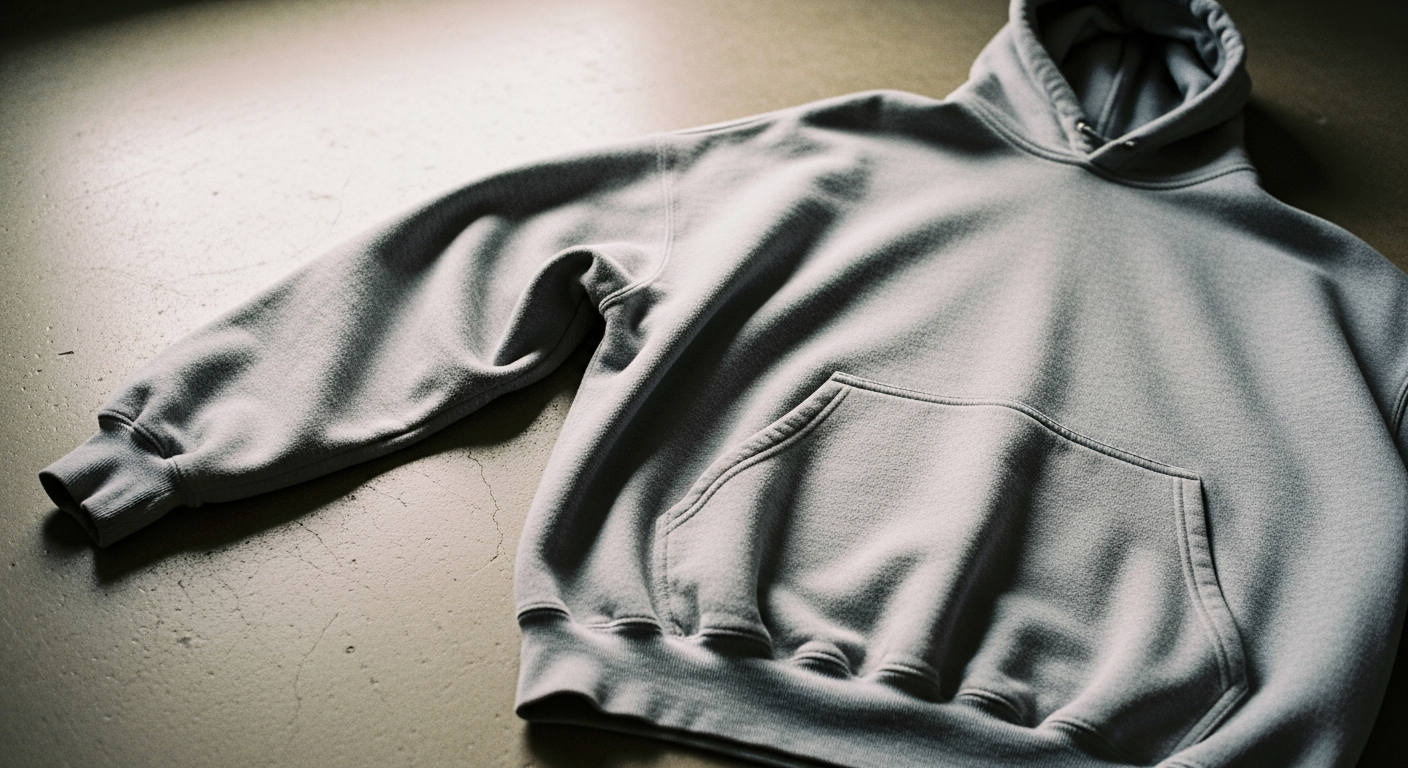
You've been buying oversized wrong. The difference between looking deliberately loose and looking like you borrowed your dad's clothes isn't the size—it's whether the shoulders, sleeves, and body length are engineered for proportion, not just scaled up.
Most brands take a medium and multiply every dimension by the same factor. That's how you end up with sleeves that hang past your knuckles and a hem that puddles around your thighs. Real oversized fit isn't about taking a normal hoodie and making it bigger—it's about building a garment from the ground up where every panel is cut to hold shape at a larger scale. The shoulder seam has to hit where your arm actually hinges. The sleeve has to taper so it stacks at your wrist instead of swallowing your hand. The body needs length, but not so much that it collapses under its own weight.
That last part—collapsing under its own weight—is where fabric density becomes the deciding factor. Lightweight hoodies stretched to XXL don't have the structure to hold an intentional silhouette. They bag at the elbows, sag at the hem, and wrinkle across the chest because the material can't support the volume. Heavyweight construction—440GSM or higher—holds the shape even when you size up. The fabric is dense enough to create structure without stiffness. It drapes where it should and stands where it needs to. That's not an accident. It's engineered.
Cheap oversized is just big. You can feel it the first time you put it on—the fabric moves wrong, the proportions drift, and you spend the day pulling at sleeves or adjusting the shoulders because nothing sits where it's supposed to. Built oversized makes the choice look intentional. You put it on and it falls exactly where the cut said it would. The weight of the fabric does half the work. The rest is in the pattern—controlled drop shoulders, proper panel cutting, and a fit that assumes you want to look like you chose this, not like you grabbed the wrong size off the rack.
True oversized fit requires heavier material because anything lighter can't hold the volume. If a hoodie doesn't list its fabric weight, that's your first clue it wasn't built to be worn loose—it was just made big and sold as oversized because the word tested well. The difference shows up the first time you wear it.
Related from The Archive: Oversized Silhouette Collapse: Teens Are Learning That Baggy Only Works If the Fabric Can Hold Its Shape After Five Washes, Heavyweight Textile Engineering, Fabric Transparency Is the New Flex: Why Teens Are Reading GSM Labels Like They Used to Read Hype Logos